
The Curious History of Dog Kibble: How Convenience Became the Canine Norm
- Olga Rozenberg
- May 8, 2025
- 4 min read

Updated: Jan 26
Before there were pet stores, “complete and balanced” claims, or colourful bags of kibble stacked in every supermarket aisle, dogs ate whatever their humans had on hand. Table scraps, leftover meat, bones, maybe a lovingly charred sausage from the fire, canine cuisine was more about survival than science.
Historically, dog diets reflected the lifestyle and social class of their human companions. Wealthier households might have offered richer scraps or prepared meals, while working dogs lived off whatever was cheap and available. It wasn’t ideal, but it was real food.

History of Dog Kibble
That changed in 1860, when an American electrician named James Spratt noticed dogs in Liverpool scavenging for ship hardtack. Inspiration (and capitalism) struck. Spratt created Meat Fibrine Dog Cakes—a mix of wheat, beetroot, vegetables, and beef blood, which he marketed as the first commercial dog food. His target? Upper-class pet owners who wanted the prestige of a modern, “scientific” solution.
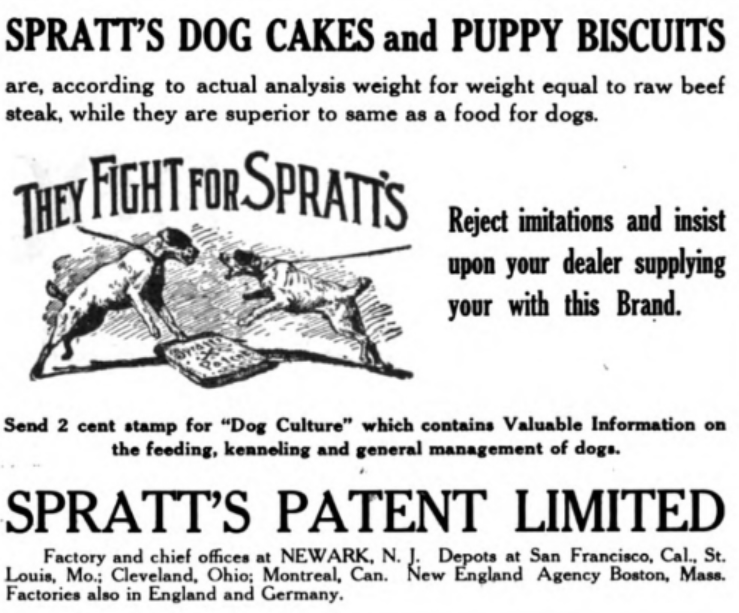
After launching his original Meat Fibrine Dog Cakes, James Spratt didn’t stop at feeding dogs, he set out to fix them. His company began producing a dazzling range of dog foods tailored to specific breeds, life stages, and even imaginary health crises. There were biscuits for bulldogs, meals for lapdogs, cod liver oil cakes for pups with delicate constitutions, and “Orphan Puppy Food” to stand in for mother’s milk.
But it didn’t end there. Spratt’s line included “Celebrated Mange Cure” and “Dog Soap” (allegedly effective against lice, fleas, and ticks), marketed as medicinal dog products, years before regulatory oversight existed. His ads promised vitality, healing, and glossy coats—all packed into crackers with beef blood and beetroot. In a time before veterinary nutrition was a science, Spratt sold the idea that his food wasn’t just sustenance—it was salvation.
A vintage Spratt’s ad from the late 19th century, boldly marketing biscuits, cod liver oil, “celebra Spratt’s Bulldog & Terrier Meal—early breed-specific dog food marketing. Spratt’s ad for puppy biscuits and early weaning foods.
In 1922, Ken-L Ration brought canned dog food to the U.S., using horse meat as its protein source. It was convenient, affordable, and heavily marketed as a complete meal. But during World War II, metal shortages throttled the canned food boom, forcing manufacturers to innovate again.
Enter the 1950s—and the rise of extruded dog kibble. Borrowing technology from breakfast cereal production, companies like Purina created shelf-stable, pellet-shaped food that was cheap to produce and easy to transport. Purina Dog Chow, the first extruded kibble, was launched in 1956.
What Are AGEs (Advanced Glycation End-Products), and Why Should Dog Owners Care?
The extrusion process was revolutionary, but not without flaws. High heat and pressure destroyed many of the food’s natural nutrients, which manufacturers then replaced with synthetic vitamins and minerals sprayed on the finished product. This process also created advanced glycation end-products (AGEs), compounds now linked to inflammation and aging.
What are AGEs?
These are harmful compounds that form when proteins or fats combine with sugars during high-temperature cooking, like the extrusion process used to make kibble. It’s the same chemical reaction that makes grilled steak taste delicious (the Maillard reaction), but inside the body, AGEs are far less charming.
Why are AGEs a problem?
In both humans and dogs, AGEs have been linked to:
Chronic inflammation
Oxidative stress (translation: cell damage fiesta)
Insulin resistance and metabolic issues
Kidney disease and cardiovascular problems
Accelerated aging and shorter lifespan
In dogs, research is still growing, but early findings suggest a strong correlation between AGE accumulation and diseases like cancer, arthritis, and cognitive decline. Basically, it’s not just what’s missing from processed dog food—it’s what’s created during the process that matters.
Why are AGEs so common in kibble?
Because kibble has to be shelf-stable, extruded at high heat, and manufactured at scale. That combo is the perfect storm for AGE formation. And then, after being cooked into oblivion, the kibble is sprayed with synthetic vitamins to make up for what was lost—like slapping a band-aid on a deep fryer.
Despite its industrial origins, kibble quickly became the gold standard of pet food.
Why? Because companies told us so. Strategic marketing and industry influence in veterinary education helped position kibble as the optimal, even superior, way to feed dogs. Over time, traditional feeding practices like raw or home-cooked diets were stigmatized as risky or outdated.
But modern research is painting a more complex picture.
Recent studies show that ultra-processing can damage the quality of proteins and fats, contributing to gut microbiome imbalances, systemic inflammation, and even shorter lifespans in dogs. As awareness grows, so does interest in alternative feeding options—raw, fresh, and lightly cooked diets that aim to support canine biology, not just industrial convenience.
Bottom line?
As we see, in the history of dog kibble, it wasn’t created by nutritionists. It was created by businessmen. From ship biscuits to cereal machines, the story of dog food is one of marketing, machinery, and modern myths. But today, we know better. And that means we can feed better, too.
Want to talk this through in the context of your dog?
A free Meet & Fit video call is a simple way to map out next steps.
References
Books & Academic Sources:
Coppinger, R., & Coppinger, L. (2001). Dogs: A Startling New Understanding of Canine Origin, Behavior, and Evolution. Scribner.
Brown, W. Y. (2013). Nutrition and the domestic dog: past, present and future. Journal of Animal Science, 91(5), 1941–1952.
Monteiro, M., et al. (2019). Effects of processing on the digestibility of dry dog food. Journal of Animal Physiology and Animal Nutrition, 103(2), 512–519.
Koshi, E. et al. (2017). The formation of advanced glycation end products in commercial pet foods. Journal of Veterinary Science.
Pilla, R., & Suchodolski, J. S. (2021). The role of the canine gut microbiome and metabolome in health and gastrointestinal disease. Frontiers in Veterinary Science.
Sandri, M. et al. (2017). Raw meat based diet influences faecal microbiome and end products of fermentation in healthy dogs. BMC Veterinary Research, 13(1), 65.
Habib, R., & Becker, K. (2021). The Forever Dog: Surprising New Science to Help Your Canine Companion Live Younger, Healthier, and Longer. Harper Wave.
Historical Sources & Images:
Lane, C. H. (1902). Dog Shows and Doggy People. London: Hutchinson & Co.
Dogdom Magazine, January 1914.
Advertisements and historical clippings from YesBiscuit (2023). “Spratt’s in Late 19th and Early 20th Century Dog Literature.” https://yesbiscuit.com

Comments